

Backup Water: Add a Buried Cistern While the Trench Is Open
Last verified: September 8, 2026
In January 2025 this town learned what it means when the water stops: dry hydrants, do-not-drink advisories, weeks of bottled and trucked water. Every rebuild in the Palisades is now at the one moment in a house's life when adding a buried water reserve is cheap — the yard is open dirt, the plumbing isn't closed in, and the excavator is already on site. This page explains the system, what it costs, and the rules that keep it legal, so you can hand it to your plumber and ask for a price.
How It Works
Three modes, one selector valve
- Straight city — normal city pressure; the tank sits full and ready.
- Through tank — everyday mode: house water passes through the tank, so the reserve refreshes itself with every shower and load of laundry. Floats refill it automatically from about 85% back up to 95%, keeping the reserve near-full at all times.
- Emergency — city valve closed, house runs on the reserve alone. 500 gallons is roughly three to five days of careful indoor use.
A wall gauge shows the tank level; alarms warn on overfill or a running-dry pump. The float sensors lift out through the access lid for service — nobody ever enters the tank.
The buried cistern in place
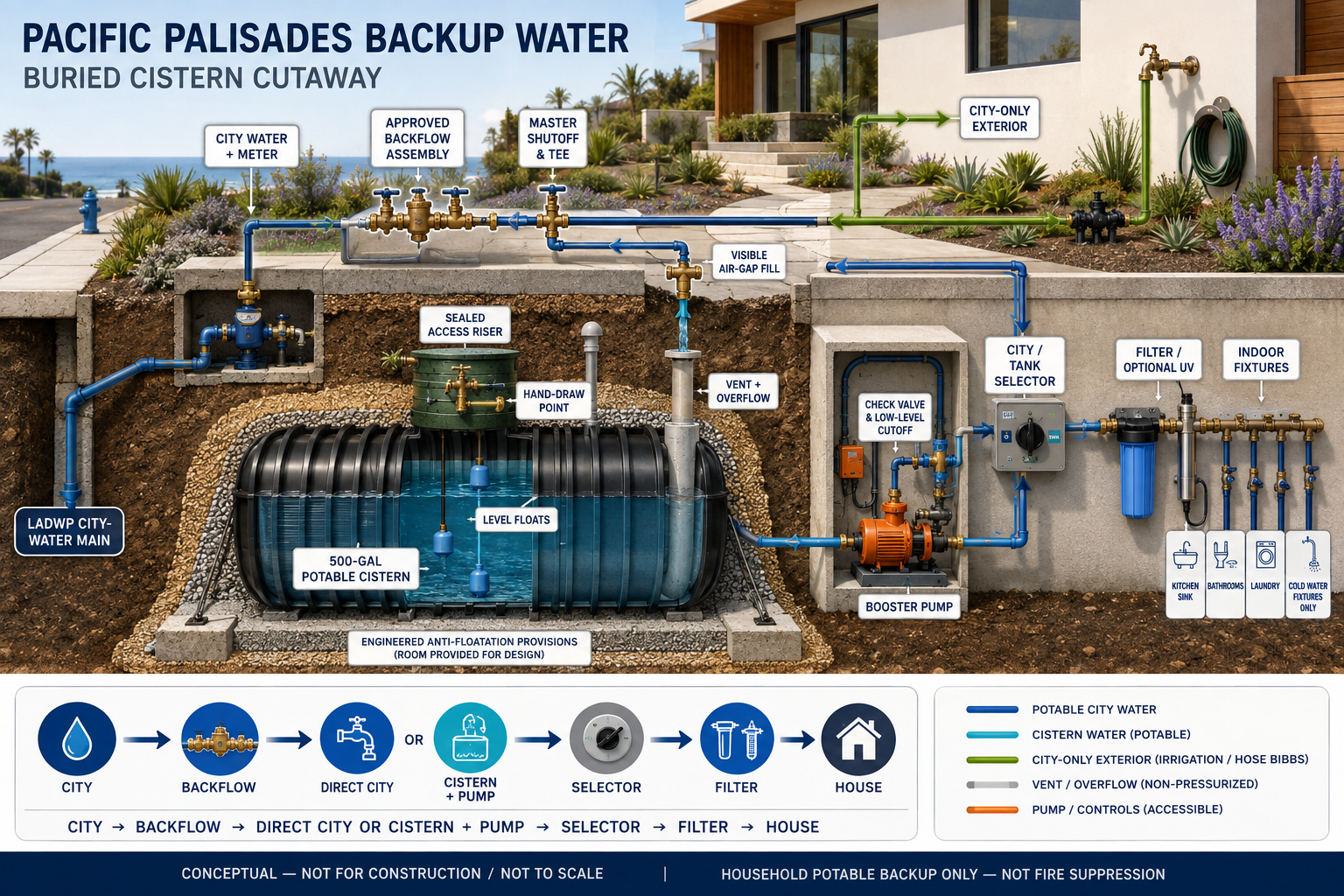
This artist’s cutaway shows how the pieces fit around a finished home: backflow protection at the service, a city-only exterior branch, the visible air-gap fill, a purpose-built tank in a non-traffic planting area, and accessible pumping and filtration equipment.
Working valve-and-filter schematic
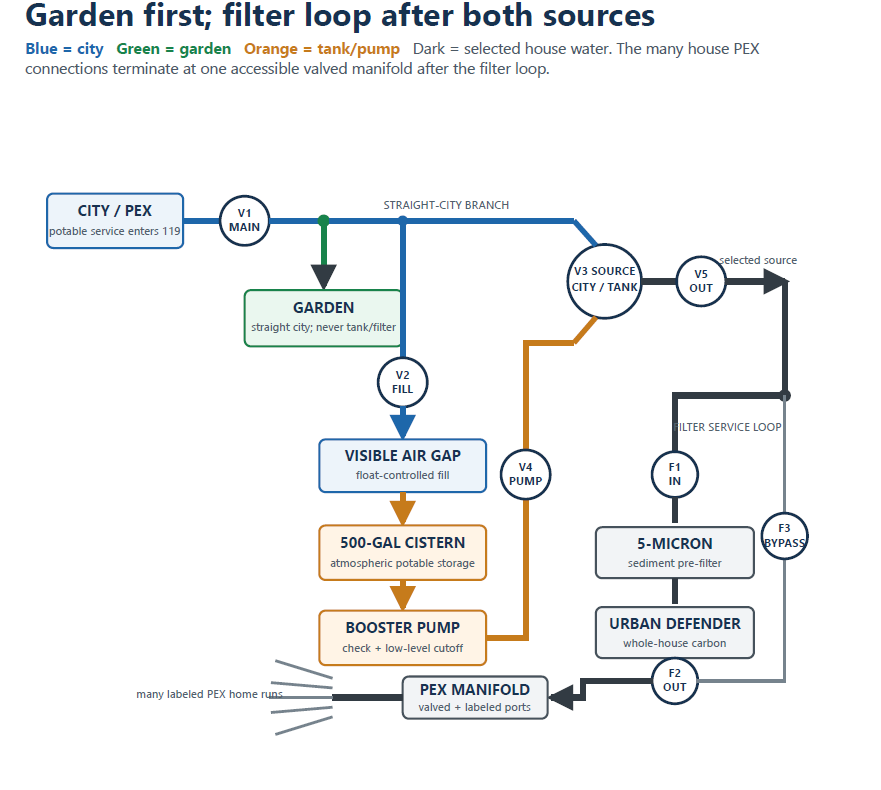
This is the original schematic you supplied: the detailed V1–V5 layout for the city branch, cistern fill, pump, CITY/TANK selector, filter service loop and labeled PEX manifold. It begins downstream of the meter and required LADWP-approved service backflow assembly; the buried-cistern cutaway above and safety rules below supply that upstream context.
The rules that make it legal (and safe)
- Service backflow protection plus an air gap. LADWP determines the approved backflow assembly at the water-service connection; Rule 16-D says there can be no hose bibb, tee, tap or other outlet between the meter and that assembly. Separately, the tank fill must fall through a visible air gap above the receiving vessel’s overflow rim. The air gap protects the tank fill but does not replace any service backflow assembly LADWP requires. Cross-Connection Control: (213) 367-3471.
- Indoor fixtures only. Hose bibbs, irrigation, pool fill and fire sprinklers stay on a physically separate city-only branch — tank water never reaches them, so a broken sprinkler head can't drain your reserve.
- A real underground tank. NSF-listed for buried potable use, bedded per the manufacturer, with counter-buoyancy engineering where groundwater is possible — never an above-ground tank dropped in a hole, and never under a driveway.
- Fail-closed fill valve. Power loss closes the fill; separate floats provide independent overfill and dry-pump protection.
- A hand-draw point at the riser. If every power source is out, you can still get water with a hand pump. Cheap, and worth insisting on.
What it costs
A complete premium installation — tank, excavation, automatic fill and level controls, constant-pressure pump, a stainless valve station and a labeled distribution manifold — planned out at roughly $19,000–$44,000 in 2026 Los Angeles pricing. A simpler version (copper instead of stainless, basic controls) lands meaningfully lower; the tank, hole and pump are the irreducible core. Two useful alternates: a point-of-entry UV lamp (~$800–$1,500) restores a disinfection barrier when you're drinking stored water for days, and if you have a standby generator, put the pump and controls on the generator-backed panel.
Why now: most of that money is trenching and plumbing that costs a fraction during construction of what it costs as a retrofit into a finished yard.
Not ready to commit? Rough it in anyway
Even if the tank isn't in this year's budget, three cheap decisions during construction keep the option open forever:
- Reserve about 30 inches of mechanical-wall space for a future valve station and filter.
- Stub and cap a water line and a spare conduit with a pull string from that wall to a plausible tank spot in the yard.
- Keep one lawn or planting area free of hardscape, mature trees and vehicle paths — a future tank needs open dirt.
Ask Your Plumber
Six questions that separate a real bid from a shortcut
- Which exact tank model is listed for underground potable storage, and what burial depth and backfill does its warranty require?
- How are all exterior lines physically excluded from tank water?
- What prevents the tank from emptying through a pipe broken in an earthquake?
- What pressure and flow reach the farthest fixture on pump power?
- What still works with the power out, and how does the pump restart after a low-level shutdown?
- Which LADWP and LADBS approvals and inspections are included in the price?
Walk away from: an above-ground tank buried in soil, a plain tee connecting pump and city water without an approved cross-connection design, any tank line that can feed a hose bibb, or a buried lid with no sealed riser.
For local plumbers and builders
Are you a licensed plumbing contractor who'd like to offer this as a packaged install for rebuilding households — or a builder pricing one now? We'd like to hear from you and can share the full design brief. Get in touch →
Official contacts
LADWP cross-connection review: (213) 367-3471 · LADBS permits and plumbing inspection: ladbs.org →
LADWP Rule 16-D backflow requirements →